
You are currently browsing the tag archive for the ‘music’ tag.
All is well at the Birth Center. The contractions seem to be intensifying more and more, but Katie hasn’t had any change in the amount of pain and discomfort. No one who works here is brazen or foolhardy enough to speculate about the time of delivery. We get the feeling that it will be later than 5:00 p.m. this afternoon.
I ate a bland lunch at the Quizno’s here at the medical center and walked past one of the nurseries on my way back. There they were — little bundles of life, flushed red and pink, wrapped tight in each baby container. When I returned to our room a few minutes ago, Uncle Bob Pollard was singing, “Happy little babies with red cheeks…you will rock them gently out of sync,” from Official Ironmen Rally Song when I returned to the room. Don’t you love it when music syncs, whether coincidentally or supernaturally, with life? If Salt-n-Pepa’s Push It comes on in a few hours, we’ll know it’s time for Katie to go to work.
We recently got our scooter back from the shop, where two recalled parts (a fuel pump seal and the connecting rod) were replaced at Yamaha’s expense. For both Katie (before she was pregnant) and me, scooting with the wind in your face causes a perma-grin, or “scooter smile” as we call it. Not a full smile, mind you…that would put you at risk of swallowing a bug. The scooter smile is more subdued, but impossible to prevent.
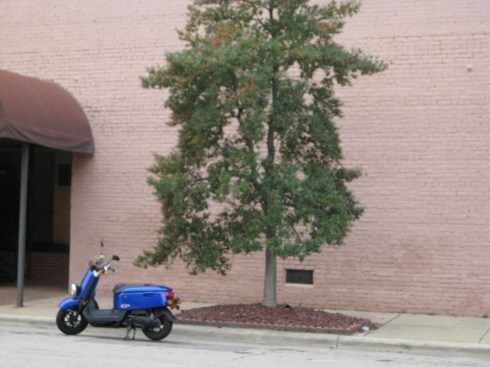
Nice whip eh?
There are several good reasons not to take yourself too seriously when you’re scooting about. For one thing, I think most people look a tad dorky (in the best possible way). I am no exception; my helmet is so big that I imagine myself looking like Lord Dark Helmet (of Spaceballs) as I drive around town.
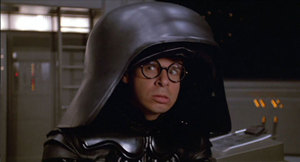
Lord Dark Helmet, scooter aficionado?
Another reason that scooter riders need a sense of humor is our slow speed relative to the rest of traffic. It’s hard to exude coolness when a Hybrid Kia can smoke you without up-shifting from third gear. Finally, people in North Carolina sometimes assume that you’re riding a scooter because you lost your driver’s license (that’s when a “Not a Liquorcycle” bumper sticker really comes in handy…thanks Steve). So, scootin’ and grinnin’ go hand-in-hand.
Best Albums of 2008
The scootin’ conditions have been pretty cold here recently, but I have managed to scoot around Five Points on the warmer days during the past two weeks. Aside from running different errands, time on the scooter has given me a chance to think back on the year in music. 2008 has really been a good one for tunes, so just like everyone else, I have my own personal “best of” list. Here’s how I rank some of the best of what I’ve heard since this time last year. Also, I reserve the right to make changes to these lists as songs/albums/artists pop into my head. I initially planned to add links to these artists or even mp3s, but I probably won’t have time before my daughter is born.
Tier One
Dr. Dog – Fate
TV On The Radio – Dear Science
Deerhunter – Microcastles
Fleet Foxes – Fleet Foxes
Cut Copy – In Ghost Colours
Tier Two
Flying Lotus – Los Angeles
Nomo – Ghost Rock
Sun Kil Moon – April
Santogold – Santogold
Hot Chip – Made in the Dark
Tier Three
The Walkmen – You & Me
Ratatat – LP3
Department of Eagles – In Ear Park
The Magnetic Fields – Distortion
Hercules and Love Affair – Hercules and Love Affair
2008 Mixtape (or my favorite 2008 singles)
MGMT – Electric Feel
Empire of the Sun – Walking on a Dream
The Field – A Paw in my Face
The Walkmen – In the New Year
Bon Iver – Creature Fear
Black Kids – I’m Not Gonna Teach You
Lykke Li – Little Bit
Big Boi, featuring Three Stacks & Raekwon – Royal Flush
Passion Pit – Sleepyhead
Department of Eagles – No One Does It Like You
Hot Chip – Ready for the Floor
No Age – Teen Creeps
Lil Wayne – A Milli
Islands – In the Rushes
Atlas Sound – River Card
White Denim – Sitting
Most Disappointing Albums
My Morning Jacket – Evil Urges
Portishead – Third
Kings of Leon – Only By The Night
Booka Shade – The Sun & The Neon Light
I’m always interested to hear some different takes on the music year in review. Leave a comment and let me know if you noticed any mischaracterizations or glaring omissions in the lists above.
You know what would make a great contest?
The Brad Mehldau Cover Challenge. Music students and/or music lovers would write a brief essay suggesting and justifying a list of 10 pop songs for Brad Mehldau to cover. Four basic rules would apply:
- The songs would have to be worthy of reinvention and should inspire something more from Mehldau than the novelty of a familiar melody in a different style
- The songs would have to suit the musicality of jazz piano (that would probably rule out most hip-hop and some electronic)
- The songs would have to be “popular music” (or music recognizable to at least one-quarter of the American population)
- The songs cannot have already been covered extensively by other artists (Architecture in Helsinki’s “Heart It Races” comes to mind…Britney Spears’ “Toxic”, Outkast’s “Hey Ya”, and Rihanna’s “Umbrella” are more poppy examples of songs that have been covered to death)
Aside from those criteria, the sky would be the limit. Prior to the submission of these essays, Brad Mehldau himself would choose the winner and create an entire album and name it in honor of that person. It would be the ultimate jazz-cover mixtape. As for my own cover choices, I haven’t fleshed out a complete album. Here’s a partial list:
- Say It Ain’t So, Weezer
- Maps, The Yeah Yeah Yeahs
- Diamonds and Pearls, Prince
- A Tear for Eddie, Ween (I know…I’m already breaking rule three)
- Here You Come Again, Dolly Parton
- Imitation of Life, R.E.M.
- God Only Knows, The Beach Boys (now I’m breaking rule four)
- If I Had a Boat, Lyle Lovett
I discovered Mehldau several years ago. It was a cover of Radiohead’s Paranoid Android that introduced me to his intensity (check it out if you don’t believe me), dexterity (he can play different melodies with each hand), and overall genius. The Brad Mehldau Trio released Brad Mehldau Trio Live (Nonesuch Records) a few months ago, an album recorded at the Village Vanguard in New York in the fall of last year. Live is Mehldau’s fourth album recorded there. It’s so good that I’ve dropped other music I’ve purchased recently and started going back through Mehldau’s earlier live recordings.

Of course, Mehldau and his current trio, which includes bassist Larry Grenadier and drummer Jeff Ballard, are much, much more than a cover band. They also play Mehldau’s original music and an equal percentage of their live sets is devoted to classic jazz standards.
When I read that Mehldau’s group recently covered Soundgarden’s Black Hole Sun on their lastest live recording, I had to pick it up. Ironically, Black Hole Sun is the only throw-away track on the two-disc set; the song is good for a round of “name that tune” with your friends, but a bit tedious at more than 23 minutes total. Now that I have my one negative comment out of the way, I can gush uninhibited about the rest of the album.
The album opens with its other pop cover, Oasis’ Wonderwall. As with any successful cover, it’s what Mehldau’s trio subtracts and adds to their version that really makes the song wonderful. The Mehldau trio’s rendition is void of the Gallagher delivery and attitude that annoyed me so much. The trio’s enhancements include a bossa nova-like rhythm, staccato and stride piano interpretation of the song’s lyrical notes (as opposed to Noel’s nasaly moans), and a bluesy-sounding, hard-driving Mehldau solo. Throughout his wandering improvisation, one of Mehldau’s hands remains true to the song’s melodic theme while the other hand explores the rest of the keyboard.
The trio’s chemistry is excellent throughout the album, but certain instances, where they nail typical jazz transitions (from a solo to the song’s head, from one solo to another solo), are remarkable and even spine-chilling. Secret Beach (a Mehldau original) really stands out to me. B-Flat Waltz, Buddha Realm (I wish my name had a cool anagram) and John Coltrane’s Countdown are other highlights. As the band leader, Mehldau and his solos loom large over most of the tracks; he covers a wide spectrum of tempos and styles. Grenadier and Ballard also shine on the rare occasions when they get the spotlight.
More importantly, all three musicians excel at conversational improvisation, whether call-and-response or a less formal kind of interplay. I’ve found that whenever I listen to any of it, I continually have to remind myself that the performance is live. Oh, and considering our weakened American economy, I have to point out that you can’t find a much better value; the two-disc set, with two and a half hours of music, has the same price point as a single album.
Playing and improvising popular music written by someone else is inherent to jazz. When a pop song is accommodated by an artist in a different genre, for a different audience, the result can be a powerful hook that draws listeners in. Some of Mehldau’s pop covers are so good, they could legitimately replace other, more dated standards.
The Mehldau contest may be my own personal fantasy, but I share my appreciation for Mehldau’s recordings with many different types of jazz fans. So, come for the familiar and stay for the new and fantastic.
Baby girl Jones is doing fine, with no real updates to speak of, so I’m making this post in lieu of baby news. I know, I know. You’re probably already disappointed.
I remember the first time I flipped through The Visual Display of Quantitative Information by Edward Tufte. My initial skim of the book was a kind of coffee-table experience — I was captivated by the aesthetics of the graphics without taking the time to appreciate their informational value. After a more thorough reading during my graduate coursework, chartjunk, small multiples, and other theoretical and practical concepts began to sink in. I remember disagreeing with more than a few of Tufte’s claims (and I still do), but I was enamored with his academic dedication to technical communication. It inspires me still today. I’ve been wondering lately…could I learn something about my musical preferences by visualizing my music’s metadata?
Even though I sometimes worry about Apple’s stranglehold on digital music, iTunes is the best digital media application available. I’ve been a loyal iTunes user for the past three years. Katie and I share our Mac, but I am responsible for 98% of the music uploaded. At a minimum, she deserves an understated tip of the hat: my wife is a good sport when it comes to my music-listening/buying/downloading habits. Since 2006, I’ve been able to collect and organize my music in ways that stacks of Case Logic albums could never accommodate. On the one hand, I miss liner notes and inserts. On the other hand, I’d prefer to filter and sort data fields click-by-click anyday over flipping through plastic sleeves in a book.
Last month, I decided to delve deeper into my (and Katie’s) music library. I began with a loosely-defined purpose and one particular variable. I wanted to analyze my song aquisition habits since the beginning of 2007 by genre. In other words, how have my musical tastes changed over the past year and a half? Of course, genre is an extremely subjective way to categorize. For example, I draw a clear line of distinction with my mind and ears between R & B, Soul, and Funk. For example, if the average person were asked to sort Donny Hathaway, Jill Scott, Poets of Rhythm, Bo Boral, and Mary J. Blige into these two genres, their results would likely be different than mine. Some artists (e.g. Rufus Wainwright, The Avett Brothers, Beirut, Air France) are pretty darn difficult to force into one bucket, but they can’t be duplicated and put into two buckets or divided among multiple buckets. I keep reminding myself that it’s okay if the genres are subjective — I’m the only one interested in dissecting my library anyway.
In most of the cases where genre blurs the boundaries of visualization, I used the category Alternative & Punk as a bit of a catch-all. As any ontologist will attest, homogeneity is crucial to characteristics of division. If genre is a characteristic of song division, then a couple of my labels don’t fit the bill. As a category label, Soundtrack is problematic because it is not homogenous with the others. Finally, the category called Blanks (also not homogenous) consists of music that has not yet been assigned a genre label.
Here’s a snapshot of my music library in July of 2008. The full data set, or all the music I own, is about 10,100 songs. The pie chart below depicts songs by genre.

Music Library, by Genre
So, World music jumped 2,450%, from two songs in December 2006 to 51 songs in July 2008. The statistically-significant increases from January 2007 to July 2008 were:
| Genre | Percentage Increase | Number of Songs 1/07 | Number of Songs 7/08 |
| Bluegrass* | 128% | 47 | 107 |
| Electronic | 81% | 214 | 389 |
| Folk | 46% | 133 | 194 |
* attributed mostly to Chatham County Line
Lounge and Metal were completely flat (no songs acquired) over the year-and-a-half period, while I only added one single Blues song (1%) and six Soundtrack tracks (3%). Increases in all the other categories ranged from 9% to 45%.
Here’s the breakdown of song acquisition by genre:

Music Acquisition Trend, by Genre
This exercise has me thinking about other variables that, when displayed visually, might reveal interesting trends or patterns. Play Count and Skip Count would really describe my listening habits, but there’s no data because I rarely play music in iTunes. I suppose I could start appending each song record in my library with My Rating, but tastes change overtime and it would be a full-time job assigning stars to every song I hear. Perhaps the next time I sort through my music, I’ll look at the gradual trend of acquiring songs and not entire albums during the last several years.
I’d certainly like to hear any ideas you may have about visualizing music collections and listening habits.
Tuesday night was Baby Jones’ first concert. Katie and I splurged on good seats to see R.E.M., Modest Mouse, and The National at Ever-Changing-Corporate-Sponsor-Blah-Blah-Something-Blah-Pavilion at Walnut Creek in Raleigh. I don’t know if her/his budding ears captured any of the night’s sounds, but I like to think the experience was something like a prenatal alt-rock primer.
The National opened with a decent short set. Their sound, at least what I’ve heard on the one album I own (Boxer), relies too much on Matt Berninger’s barritone vocals, changing instrumentation, and overall melancholy to really take over in an outdoor arena. One of the guys played the fiddle like a mandolin, but I couldn’t hear it at all. They sounded almost like a heat-withered, too-sad-to-be-angry Interpol. To be fair, anyone playing music at 6:45 p.m. in 98-degree heat has a right to be withered.

The National – persevering in the heat
Modest Mouse was on at dusk, and I knew what to expect before the band took the stage; there would be much less screaming (unfortunately for us) from Isaac Brock than when I saw them at the Variety Playhouse in Atlanta in 2001. Back then I would never have guessed that Johnny Marr (formerly of The Smiths) would be beside Brock onstage, but there he was, looking closer to a spry 24 than a seasoned 44. Their set included only a couple classics from their two Up Records releases. I can’t complain though, because Isaac did gnaw on his guitar strings for awhile during “Here it Comes”. I’m almost ashamed to admit it, but the music snob in me was pleasantly surprised when they finished without playing “Float On”. Of course, some of the whipper-snappers in attendance acted like they deserved a refund because they didn’t hear it.
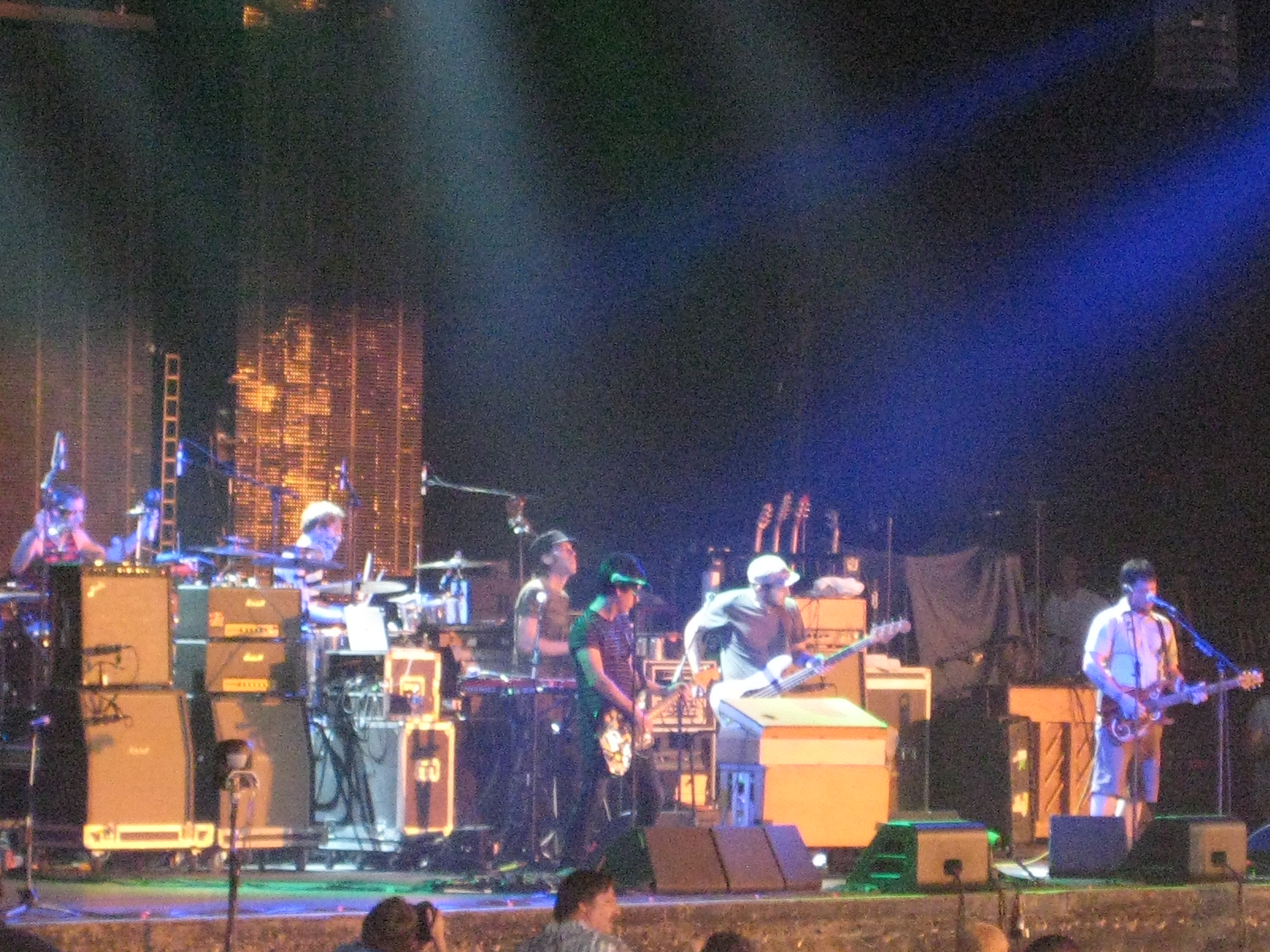
Modest Mouse – quieter than last time
After the sun set on south Raleigh, R.E.M. began with “Harborcoat”. Michael Stipe’s theatrics changed to match each new song. Mike Mills, wearing the same shirt (or so it seemed) that he was wearing when Katie first met he and Stipe in Athens, was stationed house left. Peter Buck was audible, but not really visible because he roamed a dark part of the stage most of the night. Everyone in the band, old members and new, gathered ’round the piano for a sing-along rendition of “Let Me In”.
Katie particularly enjoyed “Find The River”, “Electrolite” and “Orange Crush”, while the highlights for me were “Bad Day”, “Welcome to the Occupation”, and “Pretty Persuasion”. The only disappointments were songs I don’t really like in the first place — “I’m Gonna DJ” and the title track from Accelerate. They finished with an outstanding encore, and brought Marr, Don Dixon, and Mitch Easter on stage for a couple of songs. They closeded with “Fall on Me”, “Sitting Still”, and “Man on the Moon”. All in all, the band played like they were genuinely happy to be back in the South. The result was a memorable show for Katie and me, and probably just some vibrations for baby Jones.
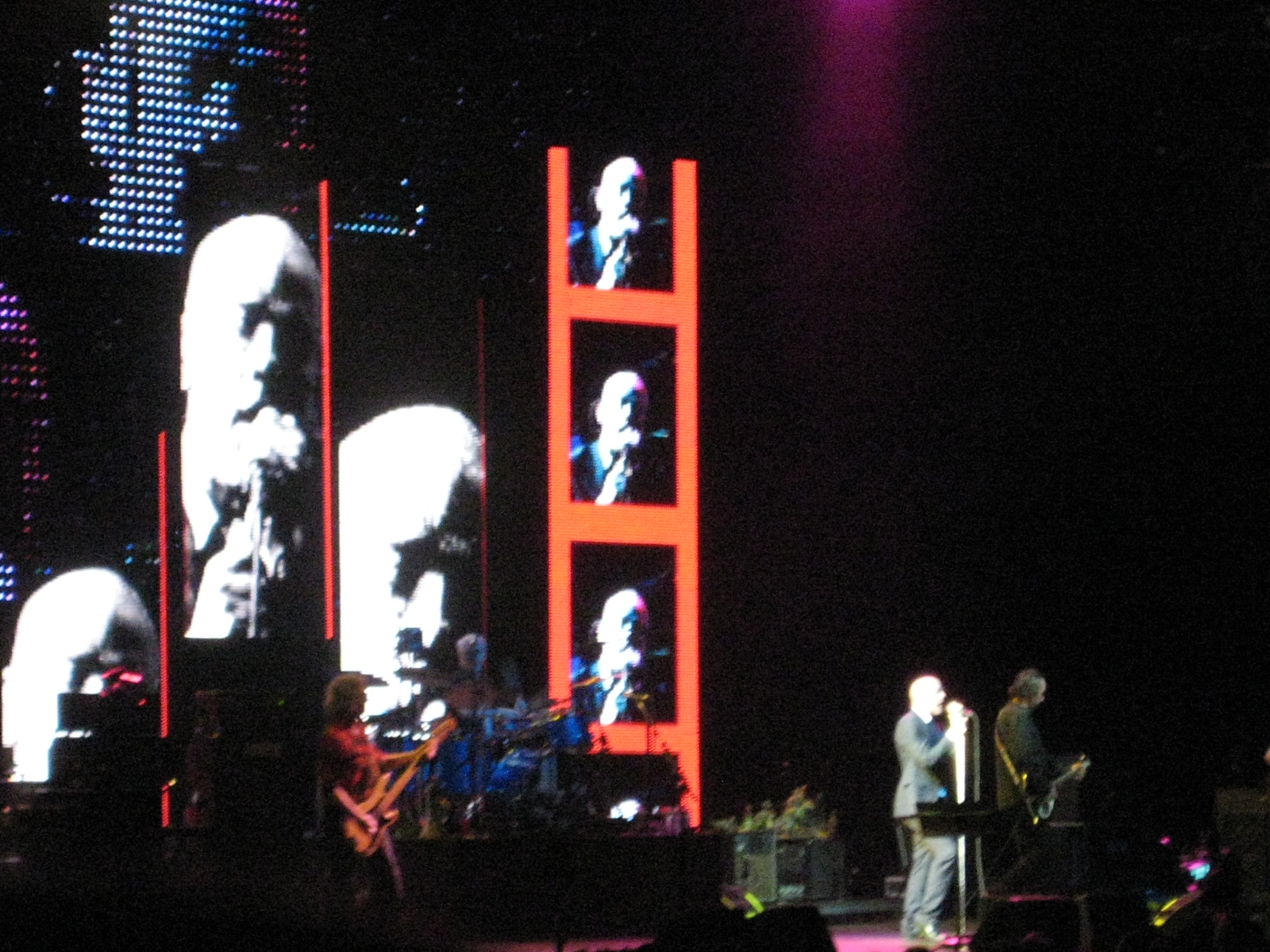
R.E.M. – “Bad Day”
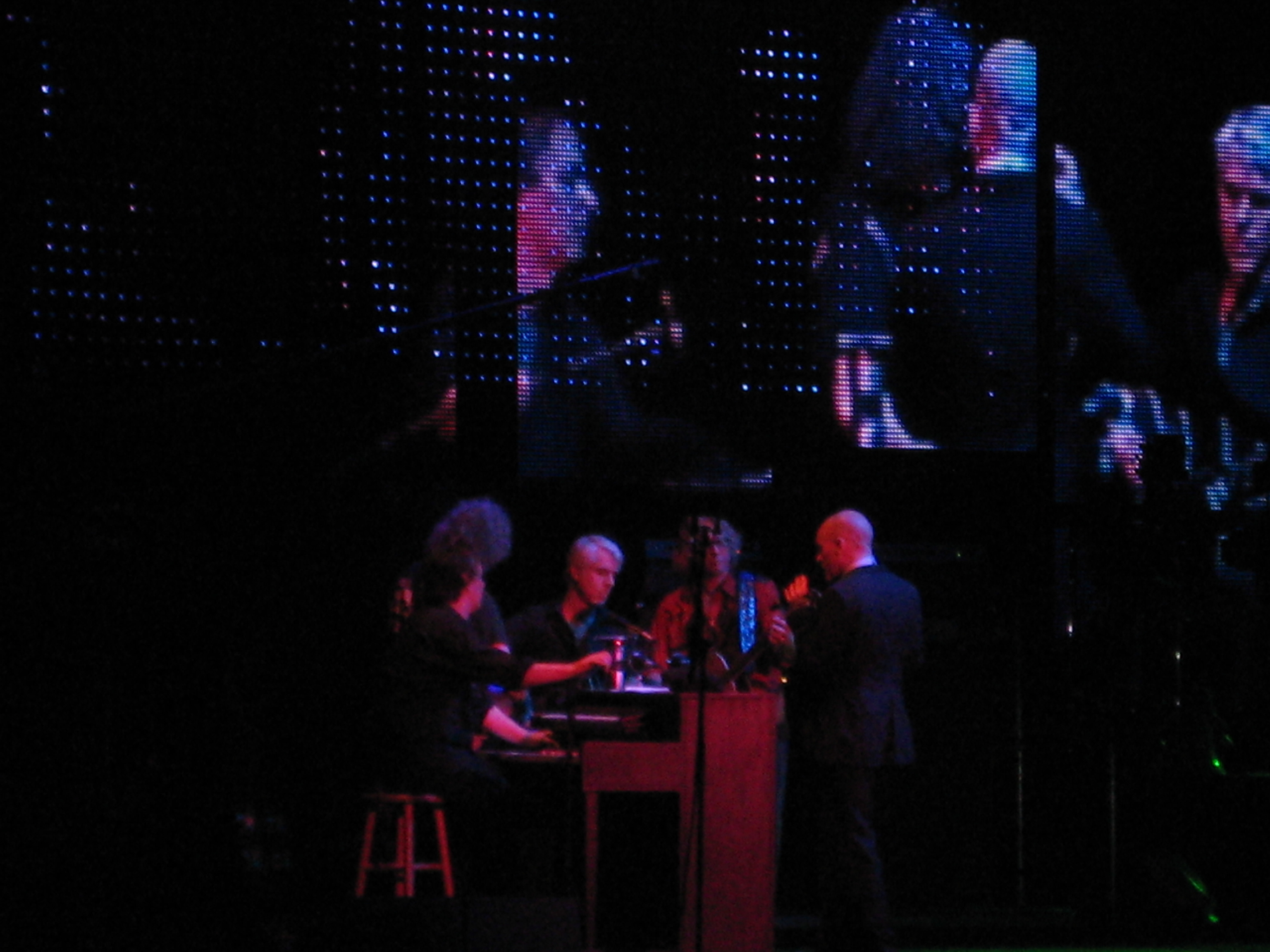
R.E.M. – “Let Me In”
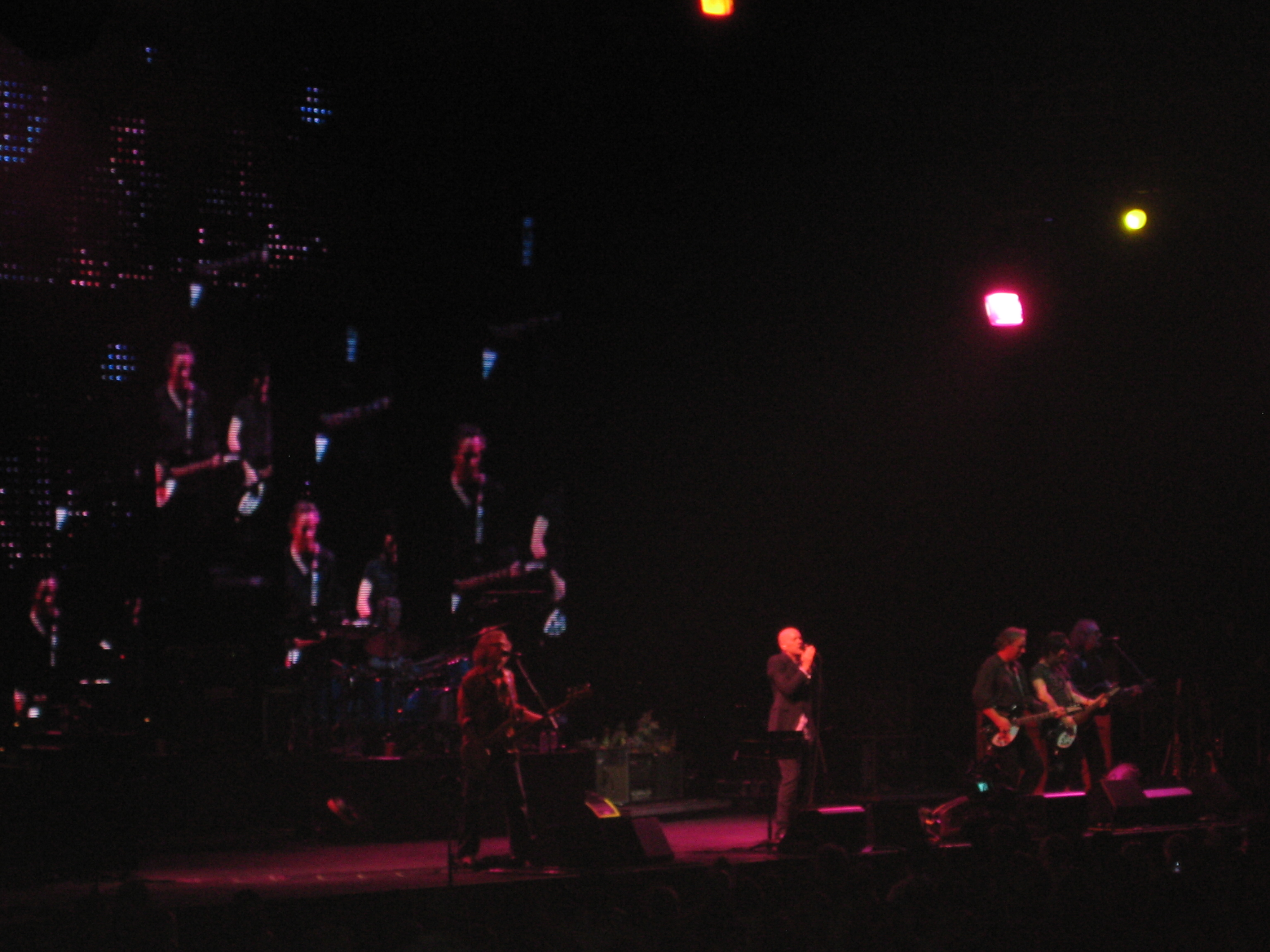
R.E.M. – “Fall on Me”
 I think I spent the dog food money